Anastasiia Sosyniuk on AI Visibility for HealthTech: My Talk at Vitalis 2026 in Gothenburg

In May 2026, I spoke at Vitalis — Scandinavia's leading digital health conference — with a session called "AI Visibility for HealthTech: How HealthTech Startups Can Stand Out in AI Search." Here's what I brought to the stage in Gothenburg, why the topic resonated so strongly with this audience, and what HealthTech companies of any size can take away from it.
What Vitalis Is
Vitalis is Northern Europe's largest and most important event dedicated to digital health, eHealth, and healthcare and social care innovation. The conference takes place every year in Gothenburg, Sweden, at the Svenska Mässan venue, bringing together representatives from municipalities, regions, government agencies, companies, and academia from across the Nordic region.
The scale speaks for itself: roughly 7,000 attendees, more than 700 speakers, and about 200 exhibitors across four days of programming. Vitalis isn't a one-off trade show — it's a genuine platform for exchanging experience, running conference tracks, workshops, a HealthTech startup showroom, networking events, and even a podcast studio, all at the same time. It was an honor to be part of the conference program alongside researchers, technology providers, and healthcare representatives from across Europe.
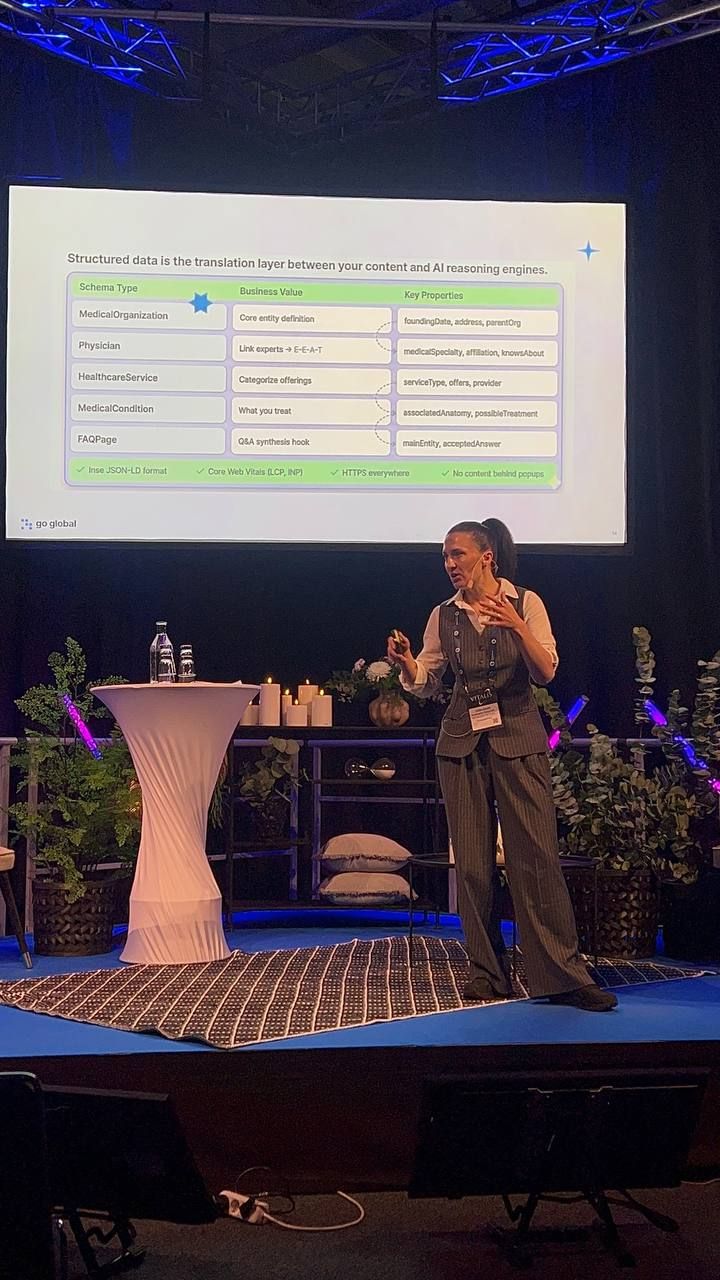
What My Talk Was About
The core message of the session was simple, yet a bit uncomfortable for healthcare marketers: visibility no longer means a ranking on a Google results page — it means whether AI trusts you enough to cite you.
Doctors, investors, and decision-makers in HealthTech increasingly turn to ChatGPT, Gemini, or other large language models for information instead of Google. This changes the very mechanics of how a company becomes visible: instead of SEO optimized for the click, companies now need Generative Engine Optimization (GEO) — a discipline focused on helping organizations become authoritative sources that AI systems recognize, trust, and cite.
The numbers I shared on stage backed this up:
-
34% of patients use AI for health queries before opening Google;
-
AI health query volume is growing +127% year-on-year;
-
conversion rate from AI search reaches 15.9% — 9x higher than traditional organic SEO.
GEO vs. Traditional SEO
One of the key points I wanted the audience to walk away with: GEO isn't just "the new SEO" — it's a different game entirely. In traditional SEO, the audience is human searchers and crawlers, the goal is a top SERP ranking, and authority is measured through backlinks. In GEO, the audience is LLMs and AI assistants, the goal is citation in AI answers, and authority is measured through E-E-A-T signals (Experience, Expertise, Authoritativeness, Trustworthiness) and entity trust.
A Five-Part GEO Playbook for HealthTech
During the session, I broke down a practical playbook into five parts:
-
Industry Insights — understanding exactly where AI looks when searching for HealthTech information. The data shows that for health queries, models rely most heavily on government and institutional sources — NIH (~39%), Healthline (~15%), Mayo Clinic (~14.8%), Cleveland Clinic (~13.8%), ScienceDirect (~11.5%). YouTube (~28%) also plays a role, where AI turns for approachable, patient-friendly explanations.
-
Technical SEO & Schema — being "agent-ready": structured data (MedicalOrganization, Physician, HealthcareService, MedicalCondition, FAQPage in JSON-LD format), Core Web Vitals, HTTPS everywhere, and no content hidden behind popups. Structured data is essentially the translation layer between your content and AI reasoning engines.
-
Earned Media Magic — getting third parties talking. 94% of all cited links come from non-paid media, and 82% of citations are earned rather than brand-owned. AI trusts independent analysis far more than brand messaging. Journalistic sources still account for roughly 25% of all AI citations — remaining a structural pillar for how models ground their answers.
-
Timing Is Everything — the 7-day "glory window." The highest citation rate for content happens within the first week after publication, and 50% of citations come from material published within the last 11 months. Freshness directly determines whether you show up on AI's radar at all.
-
Owned vs. Earned — knowing which channel to use when. Owned content wins fact-based questions: warranty, policies, specs, integrations. Earned media wins discovery questions like "which brand should I choose" — where independent expert opinion matters most.
HealthTech Is YMYL, and AI Knows It
I also made a point of emphasizing that healthcare falls into the YMYL (Your Money or Your Life) category — topics where the cost of getting it wrong is simply too high. That's why AI is especially risk-averse and demands proof that a source is safe to cite. This is where the full E-E-A-T framework comes in: experience (first-hand clinical case studies), expertise (verified credentials, MD-authored content), authoritativeness (recognition by the medical community, links from WHO and NIH), and trustworthiness (transparency, HIPAA documentation, SSL, editorial policy). Failing E-E-A-T on a YMYL site means silent exclusion — AI simply stops citing you, with no explanation.
Go Global's Double Presence at Vitalis 2026
I was glad that Go Global showed up at Vitalis with not one but two talks. My co-founder Natali Trubnikova also spoke at the conference, delivering "Selling HealthTech Is Not SaaS: A 90-Day Go-To-Market Playbook for Regulated Markets" in the Innovation Area track on May 5, 12:45–13:00 CEST.
Her point echoes mine, just from the other end of the funnel: bringing a HealthTech product to market isn't the same as scaling a traditional SaaS. Clinical validation, compliance requirements, long decision cycles, and multiple stakeholder groups turn even the most innovative solutions into slow-moving pilots — unless a startup builds a go-to-market strategy designed specifically for regulated markets.
Built on real projects with European and global HealthTech companies, Natali's session gave participants a clear, actionable 90-day GTM framework covering:
-
how to position a HealthTech solution for clinical, operational, and economic value simultaneously;
-
how to choose your first ICPs (hospitals, clinics, payers, medtech integrators) and validate demand fast;
-
the "Pilot → Evidence → Pipeline" model for turning early technical trials into commercial momentum;
-
how to shorten sales cycles by working with regulatory constraints, procurement processes, and data-governance requirements rather than fighting them;
-
what KPIs matter in the first 90 days — and what metrics waste your time;
-
common GTM failures in HealthTech and how to avoid them when crossing into new markets.
Together, our two sessions essentially covered the full cycle of bringing a HealthTech company to market: how to become visible to AI and to people, and how to turn that visibility into real sales in a regulated environment. For the Go Global team, it was a chance to showcase the end-to-end approach we bring to clients — from strategy through execution.
Why This Matters for HealthTech Startups and Teams
For founders, marketers, and communications leaders in healthcare, the main takeaway is this: visibility in the AI era is a question of trust, not ad budget. You can't buy a citation in ChatGPT the way you could once buy a spot in paid search. Instead, it takes systematic work: understanding which sources and journalists actually influence your niche (usually just about 20 key outlets drive 50% of a brand's visibility), consistently publishing content over at least a 12-month visibility window, using press releases strategically for time-sensitive queries, and checking monthly how model behavior is shifting.
The session drew founders, healthcare innovators, marketing leaders, and communications professionals looking to better understand how AI is transforming content discovery and brand visibility in the healthcare sector — and judging by the questions afterward, the topic clearly landed at the right time.
Need a Training for These Topics for Your Team?
If your HealthTech, SaaS, or other technology team wants to understand how to become visible in AI search, I run trainings and workshops — both online and offline — on the following topics:
-
AI Visibility & Generative Engine Optimization (GEO)
-
AI Search & Answer Engine Optimization (AEO)
-
B2B Marketing & Demand Generation
-
International Market Expansion
-
Content Strategy & Thought Leadership
-
Marketing Automation & AI Adoption
-
SEO in the Age of AI
Reach out — let's discuss the format and needs of your team.